
From Burnout to Balance: Rethinking Work-life Integration
- Rohan Jain
- 7 พ.ย. 2568
- ยาว 5 นาที


In Bangkok's fast-paced Thai business world, the workday no longer ends when you leave the office. It follows you home through the constant buzz of Line notifications and the expectation of late-night email responses. For countless professionals across Thailand, this "always-on" culture is pushing them towards a breaking point: burnout.
While many companies talk about achieving work-life balance, this traditional idea is proving to be an outdated and ineffective solution to a modern problem. The real challenge is not about perfectly balancing two separate lives; it is about finding a sustainable way to merge them. This is where the concept of work-life integration offers a more realistic and powerful framework.
It is not about building a wall between your job and your personal time, but about creating a healthier, more flexible relationship between them. For Thai businesses aiming to achieve talent retention, understanding and implementing this new approach is no longer just a perk. It is a strategic necessity for the future of work.
The Silent Crisis: Understanding the True Cost of Burnout

Burnout is more than just feeling stressed or tired after a long week. The World Health Organization defines it as a syndrome resulting from chronic workplace stress that has not been successfully managed. This employee burnout shows up as feelings of exhaustion, increased mental distance from one’s job, and reduced professional effectiveness.
In Thailand, this is not a minor issue; it is a widespread crisis. A comprehensive 2023 study highlighted that an alarming 73% of Thai employees have experienced burnout, a number that should concern every business leader (Intellect, 2023). Ignoring this reality has a severe negative impact and carries significant, measurable costs that directly affect the company's bottom line.
The Talent Drain
When talented team members burn out, they do not just become less effective, they leave. The cost of this talent turnover / attrition is immense. It includes the direct expenses of recruiting and hiring a replacement, the time and resources spent on training a new person, and the loss of valuable knowledge. Furthermore, high turnover can damage team morale and disrupt important projects, creating a cycle of instability where remaining employees feel even more pressure.
The Productivity Plunge
An exhausted workforce is an unproductive workforce. Employees suffering from burnout are more likely to show disengagement, make mistakes, and lack the creative energy needed for innovation. Low productivity is a direct consequence. Employees who are not given the opportunity to mentally disconnect and recover cannot perform at a high level. This leads to missed deadlines, lower-quality work, and a general slowdown in business momentum.
The Cultural Corrosion
Burnout is contagious. When a few key team members are struggling, their negativity and exhaustion can spread throughout the organization. This erodes company culture from the inside out. A modern workplace known for burning out its employees will struggle to attract top talent and will develop a negative reputation. A positive, supportive culture is a company's most powerful asset, and unchecked burnout is one of the fastest ways to destroy it, creating poor working conditions for everyone.
Why the "Work-life Balance" Model is Broken
For years, the go-to solution for workplace stress has been work-life balance. The image is one of a perfectly level scale, with "work" on one side and "life" on the other. This model suggests a rigid separation, a zero-sum game where giving more to one side means taking away from the other.
This idea is no longer realistic in our hyper-connected world. Technology has blurred the lines completely. The concept of "balance" creates pressure to achieve an impossible ideal, often leading to more guilt and stress when we fail to keep the two worlds perfectly separate.
Work-life integration, on the other hand, acknowledges that work and life are not competing forces but interconnected parts of a whole. The goal is synergy, not separation. This approach is about having the flexibility to handle life’s demands without feeling like you are failing at your job, and vice versa. This fluid approach is far better suited to the realities of modern professional life in Thailand.
A Blueprint for Healthy Integration: A Shared Responsibility
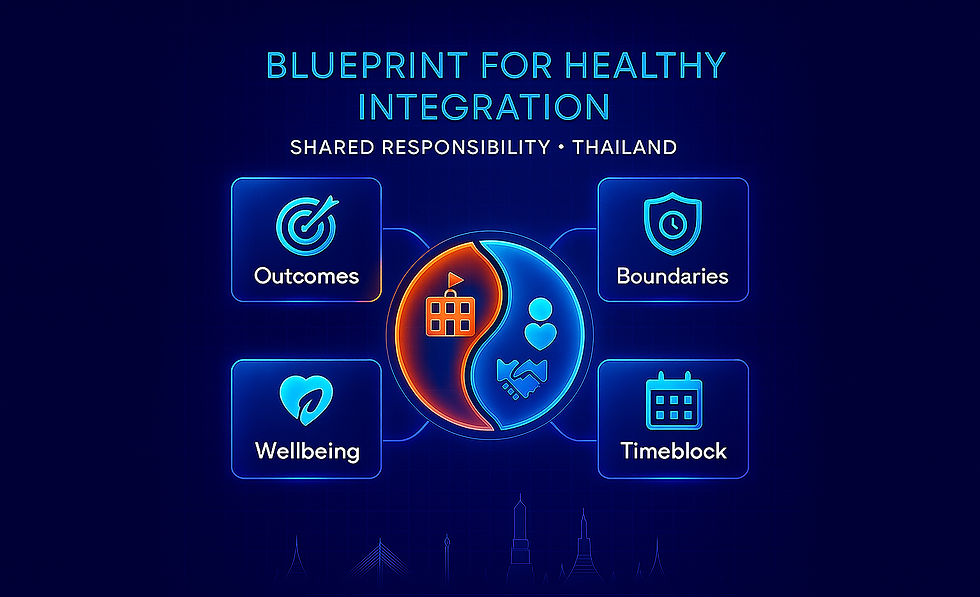
Creating a culture of healthy work-life integration is not solely the employee's job. It requires a committed, top-down effort from the organization combined with proactive, bottom-up habits from the employees themselves. Preventing burnout must be a shared goal.
The Organization's Role: Leading the Change
Focus on Outcomes, Not Hours: A key driver of burnout is "presenteeism," the belief that employees must be visible at their desks for long hours to be considered productive. Leadership must shift the focus from time spent to results achieved. As research suggests, effective performance management should reward efficiency and quality, not just physical presence (Mahidol University, 2022). This approach helps increase productivity naturally.
Build a Culture of Trust Through Flexibility: True flexibility is about giving employees autonomy and trusting them to manage their responsibilities. Companies should offer a wide range of flexible work arrangements, such as hybrid remote work models. When companies grant this trust, they see higher levels of engagement and loyalty. This is key for engaging employees.
Train Managers to Be First Responders: A project manager and other leaders have the most direct impact on an employee's daily experience. Companies must invest in manager training to recognize the early signs of burnout and champion healthy work habits. A manager encouraging employees to take breaks fosters a strong sense of belonging and helps reduce stress.
Provide Meaningful Well-being Resources: Go beyond superficial perks. Invest in a strong organizational health program with well-being resources that provide real support. This includes providing access to mental health counseling, offering workshops on stress management, and promoting physical activity. These efforts improve employees' overall health.
The Employee's Role: Taking Control
Set and Communicate Clear Boundaries: You need to teach people how you want to be treated. This means clearly defining and setting boundaries around your working hours. Use productivity tools and technology to help you, such as scheduling emails or setting your status on chat apps to "unavailable."
Use Your Calendar for Your Whole Life: Your calendar is not just for work meetings. Use effective time management to block out time for everything important to you. This includes lunch breaks, exercise, deep focus work, and personal appointments.
Practice Mindful Technology Use: The constant notifications from your phone and laptop are a major source of stress. Take control by turning off all non-essential alerts. Create intentional "tech-free" periods during your day to allow your mind to slow down.
Embrace Rest and Recovery: In a culture that often praises being busy, taking time off can feel like a weakness. It is not. Rest and recovery are essential for high performance. Using your vacation days to truly disconnect is one of the best things you can do for your career and employee well-being.
Conclusion: Building a More Sustainable Future of Work
The conversation around burnout in Thailand is reaching a critical point. The issue significantly impacts both employees and the companies they work for.
Moving from the impossible ideal of work-life balance to the practical reality of work-life integration is the most effective strategy for building a resilient and innovative workforce. It requires a deep commitment from leadership and a mindful approach from all team members.
By working on engaging employees and creating a culture of trust and flexibility, Thai business world leaders can build a healthier and more sustainable future of work for everyone.
Partnering with Hyperwork
Navigating the complexities of talent management and building a culture that prevents burnout requires expert guidance. At Hyperwork Recruitment, Thailand's leading recruitment agency, we specialize in connecting forward-thinking companies with the high-caliber talent needed to thrive in Thailand's dynamic market.
We are more than a recruitment service, we are your strategic partner in building a resilient, productive, and engaged workforce. Partner with us to secure the leadership and skills that will drive your company's success and foster a sustainable work environment.
References
Intellect. (2023). Employee burnout in Thailand: Causes, symptoms, and prevention. Intellect. https://intellect.co/blog/employee-burnout-in-thailand/
Mahidol University, College of Management. (2022). How to create a better work-life balance. CMMU. https://www.cmmu.mahidol.ac.th/en/news/1715-how-to-create-a-better-work-life-balance


ความคิดเห็น