
The Future of Hiring in Thailand & SEA
- Rohan Jain
- 15 ก.ย.
- ยาว 5 นาที


Recruiting teams in Thailand and SEA face pressure to hire faster with fewer resources. AI now supports the full funnel. It speeds screening, improves candidate experience, and helps scale hiring without adding headcount.
That is the core thesis for 2025. As a recruitment agency in Thailand, we use AI Hiring tools for recruiters to make talent acquisition in Thailand more precise and fair.
What the data says about adoption in Thailand and SEA
Global adoption is rising fast. HR leaders predicts 37% of the workforce will be impacted by generative AI within next five years, which is up from 27% late last year (Gartner, 2025). Organizations using AI in HR jumped from 26% in 2024 to 43% in 2025, with recruiting and interviewing as the top use cases (SHRM, 2025; SHRM, 2024).
In Southeast Asia the AI talent pool is growing. LinkedIn reports that the proportion of AI talent across several SEA countries has tripled since 2016, though gaps remain (LinkedIn, 2025a). Thailand is ramping up digital capabilities. Depa’s 2024 Digital Density work points to steady adoption across industries (Depa, 2025).
Thailand’s National AI Strategy highlights people development and sector pilots (NAIS, 2024). ASEAN-wide studies echo both opportunity and skills constraints as firms scale AI (Ecosystm and IBM–EDB, 2024; ASEAN Secretariat, 2024). Meanwhile, teams that lean into AI-assisted messaging are 9% more likely to make a quality hire, based on LinkedIn’s 2025 findings (LinkedIn, 2025b).
10 AI tools every recruiter should know in 2025
Resume screening and parsing AI (applicant tracking system AI). It reads resumes, extracts skills, and ranks candidate profiles. Benefit: faster shortlists from large job boards and inbound flows. Risk: biased rankings if training data skews; review edge cases under data privacy rules in Thailand (SHRM, 2024; DLA Piper, 2025).
Candidate sourcing and talent rediscovery AI. It searches profiles, alumni, and your past applicants to find potential candidates. Benefit: revives silver medalists and reduces cost per hire. Risk: stale data and consent gaps if notices are weak under PDPA (DataGuidance, 2025).
Conversational AI and chatbots for candidate engagement. It answers FAQs, pre-screens, and supports scheduling interviews. Benefit: 24/7 replies and fewer drop-offs early. Risk: brittle answers in bilingual Thai–English flows; monitor tone and escalation paths.
AI video interview analysis. It structures questions and can summarize answers. Benefit: consistent rating rubrics for the hiring team. Risk: avoid facial or emotion inference; focus on transcripts and skills evidence.
Skills and assessment AI. It builds role-based tests, simulations, or coding tasks. Benefit: skills-first hiring and clearer hiring decisions. Risk: leakage of proprietary prompts or candidate data; secure storage and clear disclosure.
ATS analytics and recruitment automation. It triggers workflows, scorecards, and nudges.
Benefit: cleaner pipeline health in real time and fewer manual handoffs. Risk: automation bias; keep a human in the loop.
Candidate experience and CRM automation. It segments talent pools and sends tailored updates. Benefit: warmer pipelines and higher offer acceptance. Risk: consent and unsubscribe management must follow PDPA and regional laws (DLA Piper, 2025).
Background check and credential verification automation. It verifies education, licenses, and work history. Benefit: faster compliance and fewer bad hires. Risk: cross-border data transfer rules; assess vendor storage and retention under PDPA sub-regulations (Baker McKenzie, 2024).
Workforce planning and talent forecast AI. It models hiring demand, skills gaps, and attrition risk. Benefit: better headcount planning and budget control. Risk: false precision; align models to finance assumptions and local labor trends (Ecosystm and IBM–EDB, 2024).
AI-assisted outreach and messaging. It drafts emails and InMails that recruiters can personalize. Benefit: more replies and better recruiter productivity. Teams using AI-assisted messaging are 9% more likely to make a quality hire, on LinkedIn’s definition of quality (LinkedIn, 2025b).
Risk: over-automation lowers authenticity; keep human edits so outreach saves time without losing voice.
How to adopt AI Hiring responsibly in Thailand
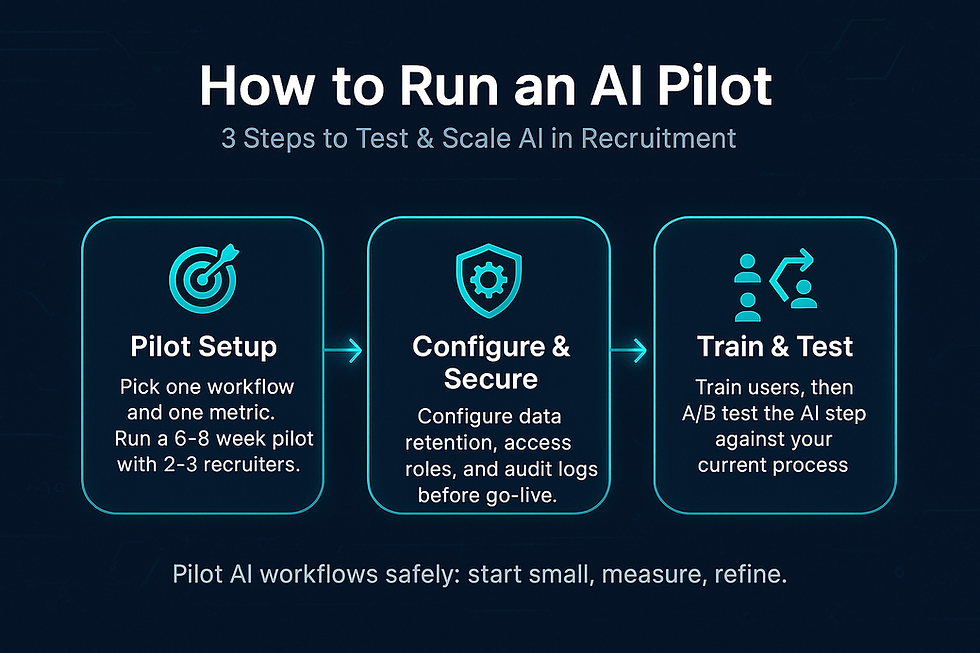
Steps to pilot a tool
Ethics, bias, and legal risks
Thailand’s PDPA governs the collection, use, and disclosure of personal data. Valid consent and clear notices matter in recruiting flows (DLA Piper, 2025). Thailand’s PDPC has issued guidance on consent and notifications that stresses fairness, purpose limitation, and clarity (Tilleke & Gibbins, 2022).
If you recruit regionally, align with Singapore PDPC’s advisory on AI recommendation and decision systems used in hiring funnels (PDPC Singapore, 2024). For cross-border processing, check transfer safeguards and contracts with processors, and track emerging PDPA enforcement updates in 2025 (FOSR Law, 2025; DataGuidance, 2025).
How to measure success

What this means for Thailand and SEA teams
AI recruiting tools can raise recruiter productivity and free time for high-value work. They also help smaller teams scale outreach across multiple markets in SEA.
Success depends on clear rules, PDPA-aligned consent, careful application processing, and strong change management. Upskilling Thailand’s TA teams remains essential to turn tools into outcomes (NAIS, 2024; depa, 2025).
How Hyperwork uses AI
At Hyperwork we use machine learning inside our hiring process to improve speed and accuracy. We semantically match job description text to candidate profiles so the hiring team sees better fits first.
We use AI to enrich and de-duplicate profiles, summarize long resumes, and flag signals about company culture alignment and long term potential with help of resume screening AI tools. We use workflow automation to route applications, schedule interviews, and update team members in real time. This saves time, cuts manual tasks, and keeps potential candidates engaged.
We also use AI to check offer readiness. We capture details on work environment, health insurance, and benefits so final offers align with market norms. For expat cases we track notes on employment contract in Thailand and required documents so handoffs are smooth. These tools support our recruitment services end to end while humans make the final call. To connect with us our team today, click on the button below.
AI is not a silver bullet. It is a force multiplier. Teams in Thailand and SEA that combine smart tools with strong process will win. If you want a partner that already uses AI tools for recruiters to improve search quality and speed, work with Hyperwork. We help you refine the hiring process, keep candidates informed, and make better, faster decisions.
References
ASEAN Secretariat. (2024, March). ASEAN for Business Bulletin. https://asean.org/wp-content/uploads/2024/03/ASEAN-for-Business-Bulletin-March-2024.pdf
Baker McKenzie. (2024). Key data and cybersecurity laws in Thailand. https://resourcehub.bakermckenzie.com/en/resources/global-data-and-cyber-handbook/asia-pacific/thailand/topics/key-data-and-cybersecurity-laws
DataGuidance. (2025, March 27). Thailand PDPC publishes factsheet on PDPA. https://www.dataguidance.com/news/thailand-pdpc-publishes-factsheet-pdpa
Depa. (2025, April 23). 2024 Digital Density survey in Thai industry. https://depa.or.th/en/article-view/20250423_01
DLA Piper. (2025). Data protection in Thailand. https://www.dlapiperdataprotection.com/index.html?c=TH&t=law
Ecosystm and IBM–EDB. (2024). The AI Readiness Barometer: ASEAN’s AI Landscape. https://www.edb.gov.sg/content/dam/edb-en/business-insights/market-and-industry-reports/the-ai-readiness-barometer-asean-ai-landscape/The%20AI%20Readiness%20Barometer-ASEAN%20AI%20Landscape.pdf
Gartner. (2025). AI in HR. https://www.gartner.com/en/human-resources/topics/artificial-intelligence-in-hr
LinkedIn. (2025a, Jan 14). Skills-based approach to harness the AI opportunity in Southeast Asia. https://economicgraph.linkedin.com/
LinkedIn. (2025b). The Future of Recruiting 2025. https://business.linkedin.com/talent-solutions/resources/future-of-recruiting
NAIS. (2024). Thailand National AI Strategy Annual Report 2024. https://www.ai.in.th/wp-content/uploads/2025/06/NAIS-Annual_2024_ENG_Web.pdf
PDPC Singapore. (2024, Mar 25). Advisory guidelines on the use of personal data in AI recommendation and decision systems. https://www.pdpc.gov.sg/-/media/files/pdpc/pdf-files/advisory-guidelines/advisory-guidelines-on-the-use-of-personal-data-in-ai-recommendation-and-decision-systems.pdf
SHRM. (2025). AI in HR. https://www.shrm.org/topics-tools/research/2025-talent-trends/ai-in-hr
SHRM. (2024). Talent Trends Survey: AI findings. https://shrm-res.cloudinary.com/image/upload/v1708634908/SHRM_2024_Talent_Trends_Survey_Artificial_Intelligence_Findings.pdf
Tilleke & Gibbins. (2022, Dec 15). Thailand issues guidelines on PDPA consent and notification requirements. https://www.tilleke.com/insights/thailand-issues-guidelines-on-pdpa-consent-and-notification-requirements/
FOSR Law. (2025, Sep 3). Thailand PDPA compliance, enforcement and cross-border transfers. https://fosrlaw.com/2025/thailand-pdpa-compliance-enforcement-cross-border-transfers/


ความคิดเห็น